


A World Beyond the Loudspeaker
40-channel wave field recording and synthesis
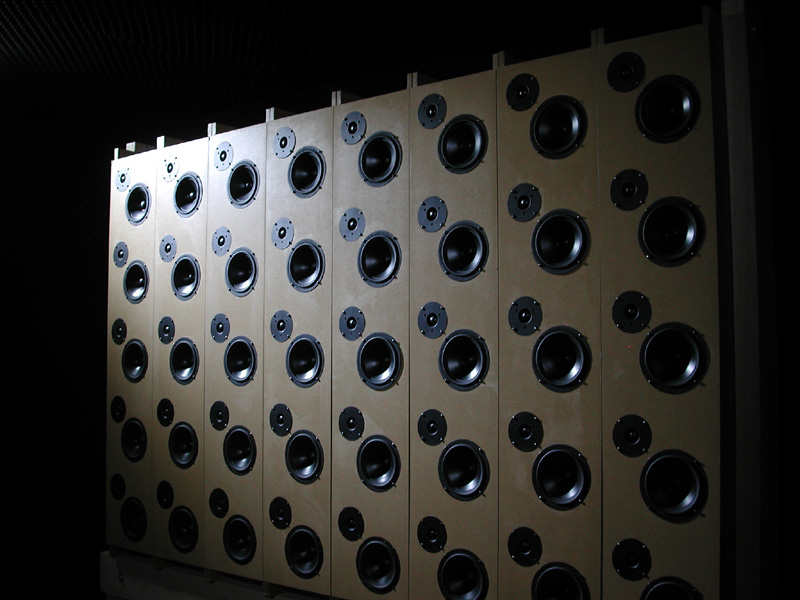
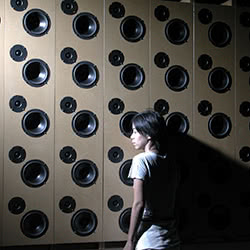
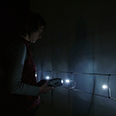
In December 1998 Edwin van der Heide realised his sound installation A World Beyond the Loudspeaker. The installation consists of a surface of 40 individual loudspeakers.
The use of this number of loudspeakers with a relatively small spacing makes it possible not only to 'simply' create vibrations in the air but also to control the spatial shape of the waves produced. Together the loudspeakers form one large spatial wave field synthesiser. Sound production based on wave field synthesis forms the basis for a realistic spatial experience unlike other multi-speaker set-ups.
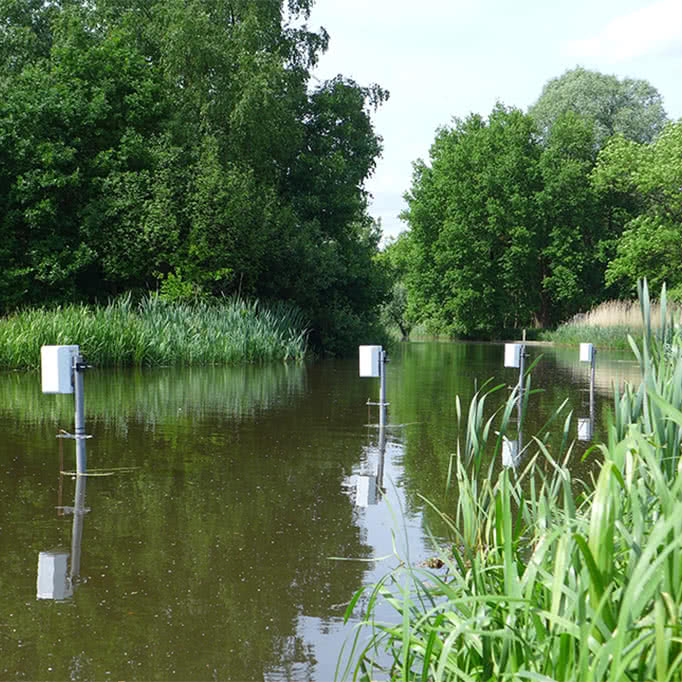
To record the sound material for the installation, an identical surface of 40 microphones was used. This surface has the same qualities as the loudspeaker surface: the grid of microphones is able to record the spatial propagation of the sound waves in the air. The final composition is played back from a 40-channel multitrack system.
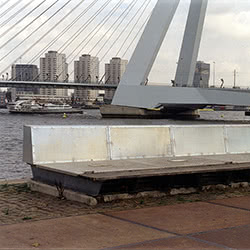
A World Beyond the Loudspeaker is a composition of concrete sounds recorded in the open field. The material consists of recordings made in industrial environments. The main focus is on the Rotterdam harbour, a train track interchange, a construction site for houses, and a shipyard. The differences in spatial nature, acoustical perspective, movement and timbre of the different locations form the basis for the compositional structure. The installation is an investigation of spatial movements represented as sonic phenomena. The result is a movie for the ear.
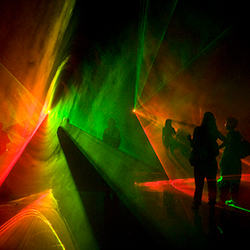
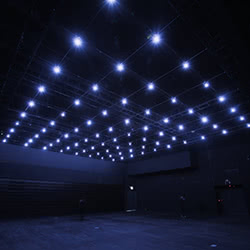
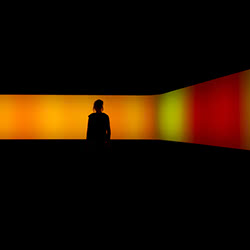
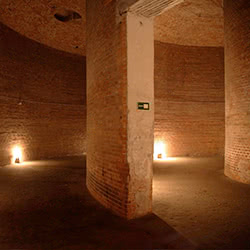
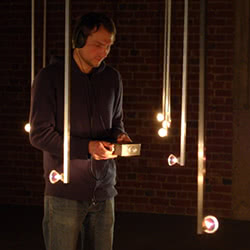
The installation is designed for an enclosed, empty space and incorporates a lighting design that evolves over time. The composition has a length of 32 minutes. There is no formal beginning or end; the composition repeats itself automatically. The audience is free to enter or leave the installation space at any time.
A World Beyond the Loudspeaker premiered on 10 December 1998 at Huis aan de Werf, Utrecht, the Netherlands, as part of the Dutch Music Days festival.
After A World Beyond the Loudspeaker Edwin van der Heide realised the installation Impuls #6 (2000), which uses the same loudspeaker set-up. Instead of wave field recording, its sound material is electronically generated and spatialised using custom wave field synthesis software.
Credits
| composition and concept: | Edwin van der Heide |
| realisation: | Edwin van der Heide and Arjen van der Schoot |
| production: | A Huis aan de Werf music production (Jacqueline Oskamp, Esther Willemse, Huis aan de Werf, Utrecht, the Netherlands) |
| technical assistance: | Jan Willem van der Vlies |
| support: | The installation was made possible with support from Fund for the performing arts Holland, Neumann Berlin, Jongeneel Utrecht and Haine Audio Rotterdam |
| keywords: | sound art, soundscape, space, new media art, sonic architecture, composition, spatial sound, installation, immersive environment, electronic, exhibition, gallery, museum, wave field synthesis, WFS, computer music, computer, technology, music, composer, artist |
Exhibitions
| 2013 | |
|---|---|
| 24 May – 31 July | CBK Groningen, Groningen, the Netherlandswith Sound Modulated Light #3 |
| 2007 | |
| 1–29 July | Klangraume Sibiu, Casa Luxembourg, Sibiu, Romania |
| 20 April – 2 June | Wood Street Galleries, Pittsburgh, USAwith Sound Modulated Light #2 and LSP (installation version) |
| 2005 | |
| BIAS Sound Art Exhibition, Taipei Fine Arts Museum (TFAM), Taipei, Taiwanwith LSP | |
| 2003 | |
| Mois Multi, Avatar / Recto Verso / Méduse, Quebec City, Canadawith Spatial Sounds (100dB at 100km/h) | |
| Sounding Spaces, ICC (NTT InterCommunication Center), Tokyo, Japan | |
| 1999 | |
| Montevideo, Amsterdam, the Netherlands | |
| Paard, The Hague, the Netherlandsreconstruction | |
| 1998 | |
| December | Huis aan de Werf, Utrecht, the Netherlandspremiere; production Huis aan de Werf |